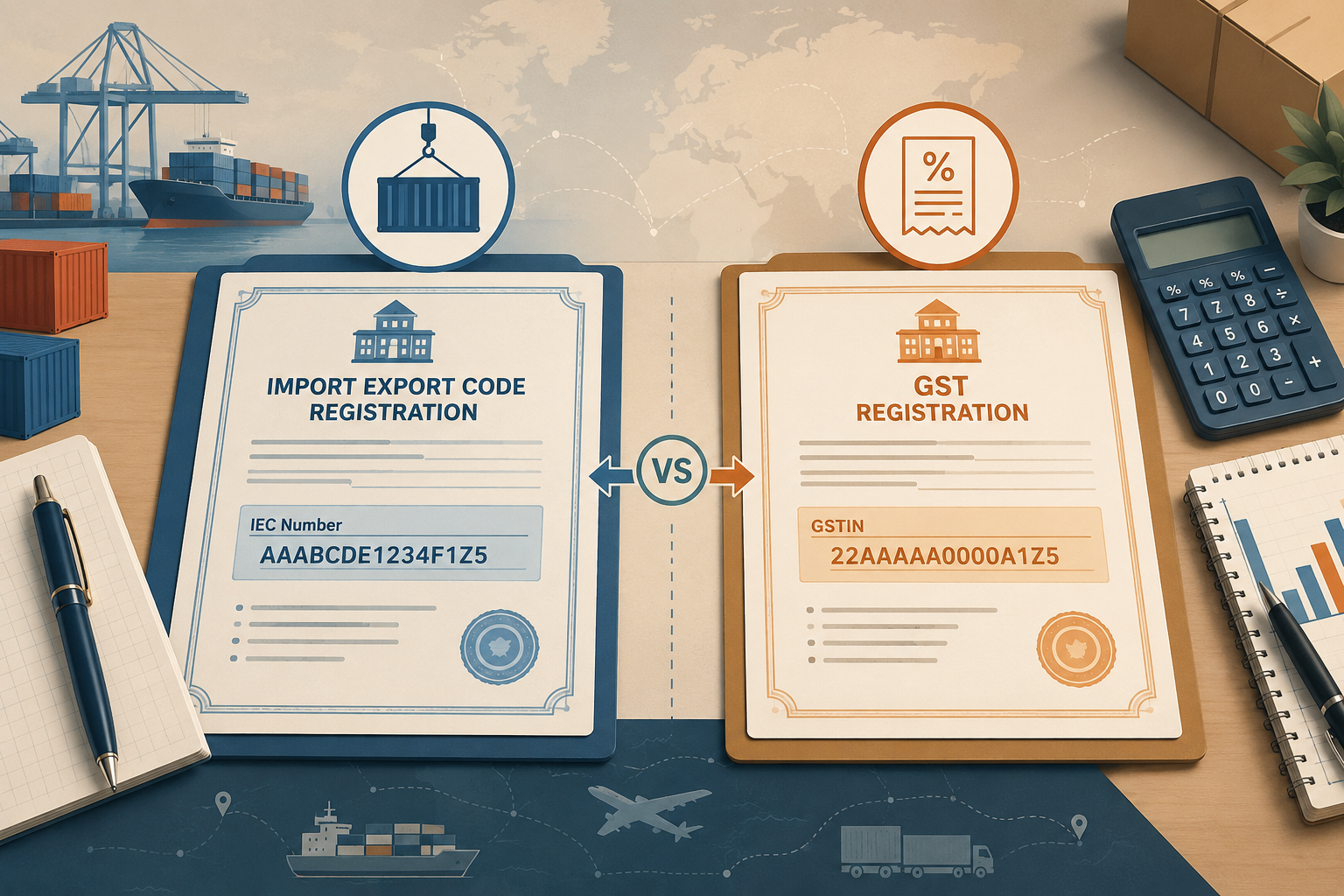
A buyer forwards you their GST certificate and says they're a legitimate exporter. You relax. Then the shipment clears, the payment doesn't come, and you realise you never checked whether they even had an IEC. These are two different registrations, controlled by two different government bodies, and one does not substitute for the other.
What Each Registration Actually Does
Let's start from first principles.
The Importer Exporter Code (IEC) is a 10-digit number issued by the Directorate General of Foreign Trade (DGFT). It's the primary business identity number for cross-border trade in India. You cannot clear goods through customs — import or export — without a valid IEC. The IEC is not tied to your tax filings. It doesn't care whether you filed your returns last quarter. It exists solely to establish that a legal entity has permission to engage in international trade.
The GST Identification Number (GSTIN) is a 15-digit number issued by the Goods and Services Tax Network (GSTN), administered through the Central Board of Indirect Taxes and Customs (CBIC). It registers a business for domestic indirect taxation. For exporters, GST matters because of the refund mechanism — goods exported from India are zero-rated, and exporters can claim input tax credit or an IGST refund. For importers, IGST is levied at the port of entry and offset against the importer's GST liability.
So in plain terms: the IEC says you're allowed to trade across borders. The GSTIN says you're registered to pay and collect tax on transactions. Both matter. Neither replaces the other.
Why Traders Mix Them Up
The confusion is understandable. Both are mandatory for most legitimate import/export businesses. Both show up on trade documents. Both have verification portals run by the government. And in practice, most established businesses have both — so traders start treating them as interchangeable proof of legitimacy.
The problem is that the IEC and GSTIN are issued independently, registered separately, and can diverge in ways that signal real risk.
A company can have a GSTIN but no IEC. This is common for domestic-only businesses that someone is misrepresenting as an export house. They can show you a valid GST certificate, invoice with GST, and look entirely professional — but they have no legal standing to export goods. If they're claiming freight forwarding or acting as an intermediary exporter on your behalf, that's a problem you'll discover at the customs gate.
A company can also have an IEC but a lapsed or cancelled GSTIN. This happens with businesses that stopped filing returns, accumulated dues, or had their registration cancelled by the tax authority. The IEC may still show as active on the DGFT portal, but a cancelled GSTIN creates complications around IGST refunds, input tax credits, and the validity of their export invoices.
And then there's the case where neither matches the business you're actually dealing with — a shell entity using borrowed or fabricated credentials. This is the fraud scenario, and it's more common than most traders want to admit.
What to Actually Check on Each
For the IEC, the core check is straightforward: look up the code on the DGFT portal and confirm the name, PAN linkage, and status. The IEC should be active, not suspended or deregistered. The legal entity name should match what's on the trade document. If the company has multiple branches or has recently changed its name, the IEC record should reflect that update — DGFT allows amendments.
For the GSTIN, the GST portal (gstin.gov.in or the taxpayer search on gst.gov.in) shows you the registration status, the principal place of business, the nature of the taxpayer (regular, composition, SEZ, etc.), and the return filing status. That last part matters. A GSTIN that's active but hasn't filed returns in six months is a yellow flag — not a proof of fraud, but worth asking about.
Beyond basic status checks, cross-referencing is where it gets useful. Does the PAN underlying the IEC match the PAN underlying the GSTIN? It should, for the same legal entity. If you're seeing different PAN numbers, you're looking at either a structuring arrangement or a document mixup — both of which require clarification before you proceed.
A Case That Illustrates the Gap
We came across this pattern during early testing of Vetrade. A trader in the textile business shared a supplier profile with us — a supposed fabric exporter based in Surat. The supplier had sent over a clean-looking document set: GST certificate, cancelled cheque, company letterhead, even a product brochure.
When we ran the verification, the GSTIN came back valid and active. But the IEC lookup returned nothing — no record under that company name or PAN. We flagged it as a Verification Gap. The trader went back to the supplier asking for their IEC. The supplier claimed they "use a freight forwarder's IEC" for all shipments. That's not how it works — the exporter of record on the shipping bill must have their own IEC, or there needs to be a specific authorised intermediary arrangement with proper documentation. The deal fell apart. Whether it was fraud or just ignorance on the supplier's part, the outcome for the trader would have been the same: money gone, goods stuck.
That's the practical risk of treating the GST certificate as a substitute for IEC verification.
How These Checks Work Together in Verification
If you're building a verification process for your business — whether you're a procurement manager, a sourcing team, or a one-person export operation — the IEC and GST checks should be treated as separate, sequential steps, not alternatives.
Start with the IEC. It's the foundational cross-border trade credential. If it doesn't exist or doesn't match, the conversation about GST is premature.
Then check the GSTIN. Confirm it's active, that the business address makes sense, and that the PAN matches what you saw on the IEC record. Look at the filing frequency if you can — it gives you a rough sense of whether this is an operating business or a dormant entity.
Then go a level wider. Does the business appear on trade directories like IndiaMART or TradeIndia? Does their website have a valid SSL certificate? Is there any news coverage that raises concerns? Do a basic Google Maps check to see if the address resolves to an actual business location rather than a residential flat or an empty plot.
No single check is conclusive. A fraudulent supplier can have a valid IEC and GSTIN. But the combination of checks makes it much harder to fake a credible profile end-to-end.
The Actionable Next Step
Before your next deal — whether you're buying or selling — run both checks on the counterparty. Don't stop at one.
IEC: search the DGFT's IEC Public Search at dgft.gov.in. Enter the company name or IEC number. Confirm active status and entity name match.
GST: search the taxpayer on gst.gov.in. Confirm the GSTIN is active, the PAN links correctly, and the return filing history looks reasonable for a trading business.
If you want both checks done together — along with B2B platform presence, news fraud scan, LinkedIn match, and SSL verification — Vetrade runs all of this in one go and shows you where the gaps are. You can run a verification at vetrade.unceasingimpex.com and view the full report on the web app. It won't replace your judgement, but it will surface the questions you need to ask before you commit to a deal.